Showing posts with label painting. Show all posts

Thursday, 21 March 2019

Georges Braque - 'Composition with ace of clubs' - 1913


Georges Braque’s principle: ‘the senses deform, but the mind forms.’
- ‘The School of Paris’ by Bernard Dorival, 1962


‘Composition with ace of clubs’- oil, gouache and charcoal on canvas – 81x60cm
Collection: Musée National d’Art Moderne, Centre Georges Pompidou, Paris

Sunday, 24 June 2018

Paul Cézanne's 'Bathers' - 1900/05

"... a feverish height rising desire for the new and the other, for a spiritualized world in contrast to the materialistic of the citizen, this call for sustainability and order, for security and freedom, for ideals and ideas, this opposition to bourgeois reality and at the same time escape from capitalist reality with its propriety of all living and its bonds, with its dehumanization of all humanitarian values, with its increasingly violent and extended problems, this opposition to an outer world and this flight to an inner world, is characteristic and stimulating at the same time." - Opposition of Abstract Art by K. Farner (1964 WB/ Cézanne 1904: father of the future painting, founder of a new platonic empire of the mind)


Paul Cézanne, ‘Bathers’ – 1900/05 - OOC 73 x 92cm – Private Collection

Thursday, 7 June 2018

'Portrait de Guillaume Apollinaire' by Jean Metzinger, 1910


"to permanent undermine the virtuous power" - Guillaume Apollinaire


Guillaume Apollinaire by Jean Metzinger - VMAN
“Guillaume Apollinaire” by Jean Metzinger (FR, 1883–1956) ooc - 55 x 46 cm

Thursday, 15 February 2018

Grey paint strokes - Gerhard Richter 1968


"My method or my expectation which, so to speak, drives my to painting, is opposition. I expect that something will emerge that is unknown to me, which I could not plan, which is better, cleverder than I am, something which is also more universal." - On the Monochrome and Abstract Paintings - Gerhard Richter from 'Interview with Benjamin Buchloh', 1988

Vman.be - Gerhard Richter
‘Grauschlieren’ (Grey paint strokes), 1968 – OOC 200x200cm
Private collection Gerhard Richter Archiv, Staatliche Kunstsammlungen Dresden

(opposition: active resistance against the ruling majority)

“Grey is the epitome of non-statement, it does not trigger of feelings or associations. (It is) an illusion, like a photograph. And like no other colour, it is suitable for illustrating ‘nothing’. For me the grey is the only possible equivalent for indifference, for the refusal to make a statement, for lack of opinion, lack of form.” - Graue Bilder by G. Richter

Wednesday, 18 October 2017

Emilio Vedova "Image of Time" - 1951

“Your actual duty is that of saving your dream.”- quote Amedeo Modigliani

 
Artist Emilio Vedova at work in his studio in Venice, 2003

"Abstract art has found the unexpected confirmation in atomic physics. All the material is dissolved in forces." - Dr. K. Farner, 1964 'Uprising in abstract art

 
‘Image of Time’ (Barrier),1951 – Egg tempera on canvas 130 x 170 cm, Peggy Guggenheim Collection, Venice


Emilio Vedova, Plurimo nr. 4 – Absurd Berliner Journal, 1964 Wood and iron, 206 x 360 cm. (Artist collection)

Wednesday, 11 October 2017

Van Gogh Vincent "Postman Joseph Roulin" - 1889


"In my opinion, I am often wealthy, not in money, but (not all days though) rich because I found my work. Something which I live for with heart and soul and that gives passion and meaning to life." - Vincent Van Gogh, The Hague, March 11, 1883

Portrait of the Postman Joseph Roulin - Ooc 65 x 54 cm. Arles: April, 1889 - Otterlo: Kröller-Müller Museum
 
"Now I'm working on a different model, a postman in blue uniform decorated with gold, a big bearded head, very sociable. [...] A more interesting man than many other."

Friday, 28 July 2017

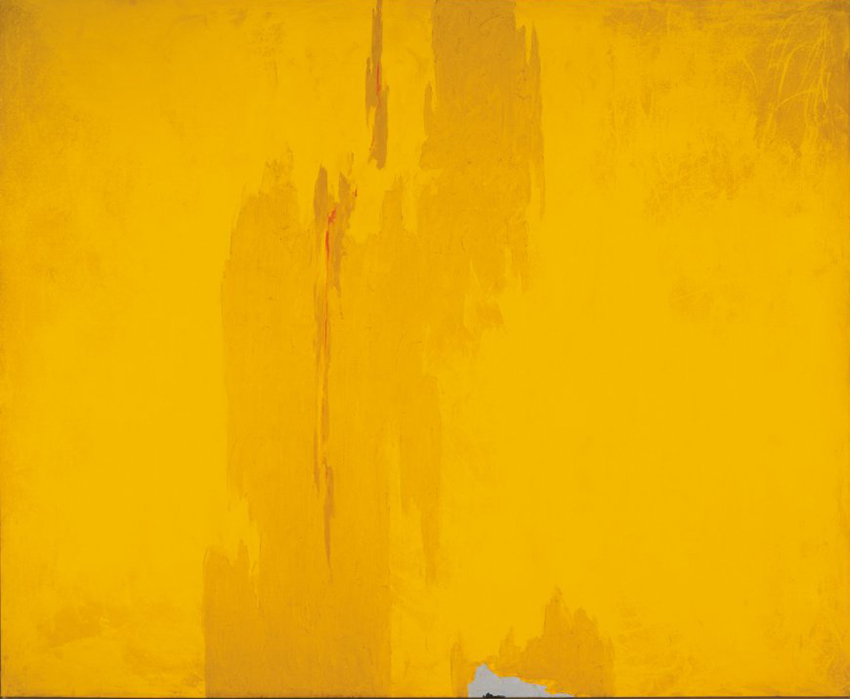
Still Clyfford's '1951-E'

Still Clifford - Collection Albright-Knox Art Gallery
1951-E , 1951 by Still Clyfford,  American (1904-'80), OOC - 297 x 363 cm
Collection Albright-Knox Art Gallery, Buffalo, New York (Gift of the artist, 1964)

"He rose above the commonplace that oppressed him."
Andrew Graham-Dixon about Still Clyfford in ‘Art of America’

Friday, 30 December 2016

Giacomo Balla "Automobile Speed + Light + Noise" - 1913


“The obsession to penetrate, to conquer by all means the sense of the real, to identify with life in all fibers of our body, is at the base of our search and at the base of the esthetics of all times.” – Gino Severini ‘remarks on evolution’, Le Mercure de France, 1917

Giacomo Balla - Automobile Speed + Light + Noise - 1913

Giacomo Balla (1871-1958) - Velocità d’automobile + luce + rumore, 1913
Distemper on canvas, 87 x 130 cm - Kunsthaus Zürich Collection

Theodoros Stamos "Ancestral Worship" - 1947


“Such work was the only valid response to the ‘neurosis which is our reality’.  As such, it was not abstraction at all, but ‘the realism of our time’.”  – Adolph Gottlieb (1903-1974) / The individual and the social, Introduction to the American Avant Garde
Theodoros Stamos
Theodoros Stamos (1922-97), Ancestral Worship, 1947. Collection: Estate of Theodoros Stamos

‘The American Abstract Expressionists ‘ by Nina Leen for Time/Life, 1951

american abstract expressionists
 
Pictured from left rear: Willem De Kooning, Adolph Gottlieb, Ad Reinhardt, Hedda Sterne; next row: Richard Pousette-Dart, William Baziotes, Jimmy Ernst, Jackson Pollock, James Brooks, Clyfford Still, Robert Motherwell, Bradley Walker Tomlin; foreground: Theodoros Stamos, Barnett Newman and Mark Rothko. Missing from photo: Weldon Kees, Fritz Bultman and Hans Hofmann.

 
James Brooks (1906-1992) – “ISEN”, 1966 (Acrylic on canvas, 48 x 72 inches)

"The social condition of the modern world, which gives every experience its form, is the spiritual breakdown which followed the collapse of religion. This condition has led to the isolation of the artist from the rest from society. The modern artist's social history is that of a spiritual being in a property-loving world."- Robert Motherwell 'The Modern Painter's world', NY 1944.

Thursday, 8 December 2016

Paul Cézanne "The Mont Sainte-Victiore" -1887


“There is a colour logic… The painter must obey it and nothing else.” - quote Paul Cézanne

Paul Cézanne The Mont Sainte-Victiore
Cézanne, Paul (1839-1906) Collection: The Samuel Courtauld Trust, The Courtauld Gallery, London

Saturday, 3 December 2016

Kandinsky 'first abstract watercolor' 1910


“The tendency toward abstraction is the consequence of man’s deep turmoil in confronting the world,” writes Wilhelm Worringer. “Ruined by the presumption to know, modern men finds himself as helpless as primitive man before the image of the world.”

Kandinsky First abstract
Wassily Kandinsky Untitled (First abstract watercolor painted at age 44 !) 1910; Munich / Monaco, Germany
Media: watercolor, paper - Dimensions: 196 x 188 cm / Collection: Georges Pompidou Center, Paris, France

Thursday, 24 November 2016

Jackson Pollock 'Convergence' - 1952


“To understand art depends upon the ability of the individual to perceive essentials, to perceive that which is called universally significant, and to evaluate the unity and relationship that is contained in any work.” – American Abstract Artist, Editorial Statement, 1938

Jackson Pollock Convergence 1952

Jackson Pollock, American, 1912-1956, Convergence, 1952, Oil on canvas, 93-1/2 x 155", Albright-Knox Art Gallery, Buffalo, N.Y., Gift of Seymour H. Knox Jr., 1956, © 2008 The Pollock-Krasner Foundation / Artists Rights Society (ARS), New York.

"Abstract art has found the unexpected confirmation in atomic physics. All the material is dissolved in forces." - Dr. K. Farner, 1964 'Uprising in abstract art'

Tuesday, 18 October 2016

Maria Blanchard - 'Man with guitar' 1918

"Yet it does not matter who is exempted from this crisis, so long as cubism is not. For cubism is still the only vital style of our time, the one best able to convey contemporary feeling, and the only one capable of supporting a tradition which will survive into the future and form new artists." "The great art style of any period is that which relates itself to the true insights of its time." - Clement Greenberg 'The Decline of Cubism', Partisan Review NY 1948.

Maria Blanchard Man with guitar 1918

Maria Blanchard (Santander, Spain 1881 - Paris, France 1932) >
‘L’homme à la guitare’ 1918 - OOC, Kröller Müller colletion, Otterlo NL

“The painter will regard the untouched canvas as an area where she/he can post constructions of the mind.” - Introduction to contemporary painting (Cubism and Abstract Art) by H.Casteur & A .Smeets, 1959

Monday, 29 August 2016

Pablo Picasso's "Les Demoiselles d'Avignon" - 1907


 “Every now and then one paints a picture that seems to have opened
a door and serves as a stepping stone to other things.” Pablo Picasso

Les Demoiselles d'Avignon - piccaso
Les Demoiselles d'Avignon (The Young Ladies of Avignon, and originally titled The Brothel of Avignon)
Oil on canvas,  size: 243.9 cm × 233.7 cm (96 in × 92 in) 
Location: Museum of Modern Art - Acquired through the Lillie P. Bliss Bequest, New York City


“Les Demoiselles d'Avignon” is one of the most famous works of Pablo Picasso (1881-1973). It is painted in a period of nine months during 1906 and 1907, when Picasso had retreated himself to a small village in the Pyrenees. When he showed the painting to his avant-garde friends, they fell silent. Only Matisse broke out laughing.
Picasso was during a visit to the Museum of Ethnography in Paris captivated by the magical fetishes, objects that were made for the expulsion of evil spirits. Against the writer André Malraux Picasso speaks of the work as "my first devils elimination painting".
In 1916 it was shown in a private room. The name of this salon was then temporarily changed from "Le bordel d'Avignon" to "Les Demoiselles". The canvas was only shown in public for the first time in 1937. In 1939 the Museum of Modern Art in New York City bought it. It still hangs there.
(source: Honour & Flemming, General art history, Meulenhoff, Amsterdam NL).


The Turkish Bath Ingres

The Turkish Bath’ by Jean-Auguste-Dominique Ingres, 1862-63. Louvre, Paris
Andrew Graham-Dixion in 'The Art of France' about The Turkish Bath’ : "It is the painting that marked the beginning of Modern Art. With this painting Art declared itself, forever, to be the creation of the individual, cut adrift from tradition."


Monday, 22 August 2016

William Turner's "Goldau" - 1841


Many artists suffered from Turner's syndrome: They tried to get the sublime from the inside on the canvas - the main symptom of this syndrome. For Kazimir Malevich the sublime was a black square. He called the black square "the face of God." Wassily Kandinsky believed that art is created by God and artist together. Barnett Newman captured the sublime in "the pure idea”. Mark Rothko wanted his paintings to spread a transparent light from the wall. Sunlight, maybe. The symptoms may differ in nuances, the diagnosis is the same in each case.
Source: Article> Volkskrant> Visual Arts> By Joost Zwagerman January 6, 2015

Zwagerman look at Joseph Mallord William Turner (1775-1851), the ‘Legitimate grandfather of 20th-century abstract expressionism’.
Discussion: Many artists suffered from Turner's syndrome, the British painter who wanted to capture the sunlight. And thus God.

Goldau - Joseph Mallord William Turner (1841) - Private Collection
Style: Romanticism - Genre: landscape
Media: watercolor, paper - Dimensions: 30.5 x 47 cm
 

22 august 2016 we celebrate our second year of “anartlovers.blogspot.be”

with more than 60% growth. Go forward artlovers!


Wednesday, 10 August 2016

Fernand Léger 'Soldiers playing cards' - 1917


“Physical nature is nothing but a memory, like a tale about something marvellous that has long since disappeared. The Factory-Town dominates everything. …
Robot-like we have become habituated to life – getting up, going to bed, eating and working to set times; and this sense of rhythm and mechanical harmony is reflected in our entire life, cannot but be reflected in our mode of thought, in our spiritual life, in art.” – A. Shevchenko /1912

fernand léger soldiers playing cards 1917


Saturday, 6 August 2016

Gustav Klimt 'Judith I '- 1901

 
“The aim of art is to represent not the outward appearance of things,
but their inward significance.”- Aristotle (384-322 VC)


Gustav Klimt (1862-1918) Judith I (Judith and Holofernes-6e VC),
1901 Oil and gilding on canvas 84 x 42 cm
Location: Österreichische Galerie Belvedere Belvedere, Vienna.
 

Wednesday, 3 August 2016

Ernst Ludwig Kirchner's "Two Women in the Street" - 1914


“With faith in progress and in a new generation of creators and spectators, we call together all youth. As youth, we carry the future and want to create for ourselves freedom of life and of movement against the long established older forces. Everyone who reproduces that which drives him to creation with directness and authenticity belong to us!” – Ernst Ludwig Kirchner (1880-1934) Programme of Die Brücke – 1905

ernst ludwig kirchner
Two Women in the Street - 1914, oil on canvas, size: 120.5 x 91 cm
Location: Kunstsammlung Nordrhein-Westfalen, Dusseldorf


Tuesday, 26 July 2016

Egon Schiele "Mime Van Osen" 1910


“The value of a line, of a form consists for us in the value of the life that it holds for us. It holds its beauty only through our own vital feeling, which, in some mysterious manner, we project into it.” – Wilhelm Worringer (1881-1965) from ‘A contribution to the psychology of style’- 1906

mime van osen
Location: Courtesy of The Leopold Museum, Vienna
Technique: charcoal on watercolor, size: 37,8 x 29,7 cm
 

Saturday, 2 July 2016

'Leaving the factory' by Bart van der Leck - 1917

Bart van der Leck (NL,1876-1958) – Composition no.3 (Leaving the factory)
Oil on canvas, collection Kröller-Müller Museum, purchase 1917
Portret source:  J.D. Noske / Anefo; - Nationaal Archief, CC BY-SA 3.0 nl.

“Man has become a tool of his own work, and has no more sense, since he serves the machine. It has stolen him away from his soul. And now the soul demands his return. This is the vital point. All that we experience is but the strenuous battle between the soul and the machine fort he possession of man. We no longer live, we are lived; we have no freedom left, we may not decide for ourselves, we are finished, man is unsouled, nature unmanned.” – Hermann Bahr, Expressionismus, Munich 1914